Why Remote Work is Redefining the Future of Business in the UK?
The way businesses operate across the UK has undergone a fundamental, data-backed transformation. From London to Manchester and Birmingham, companies are moving away from traditional office models and embracing flexible working environments.
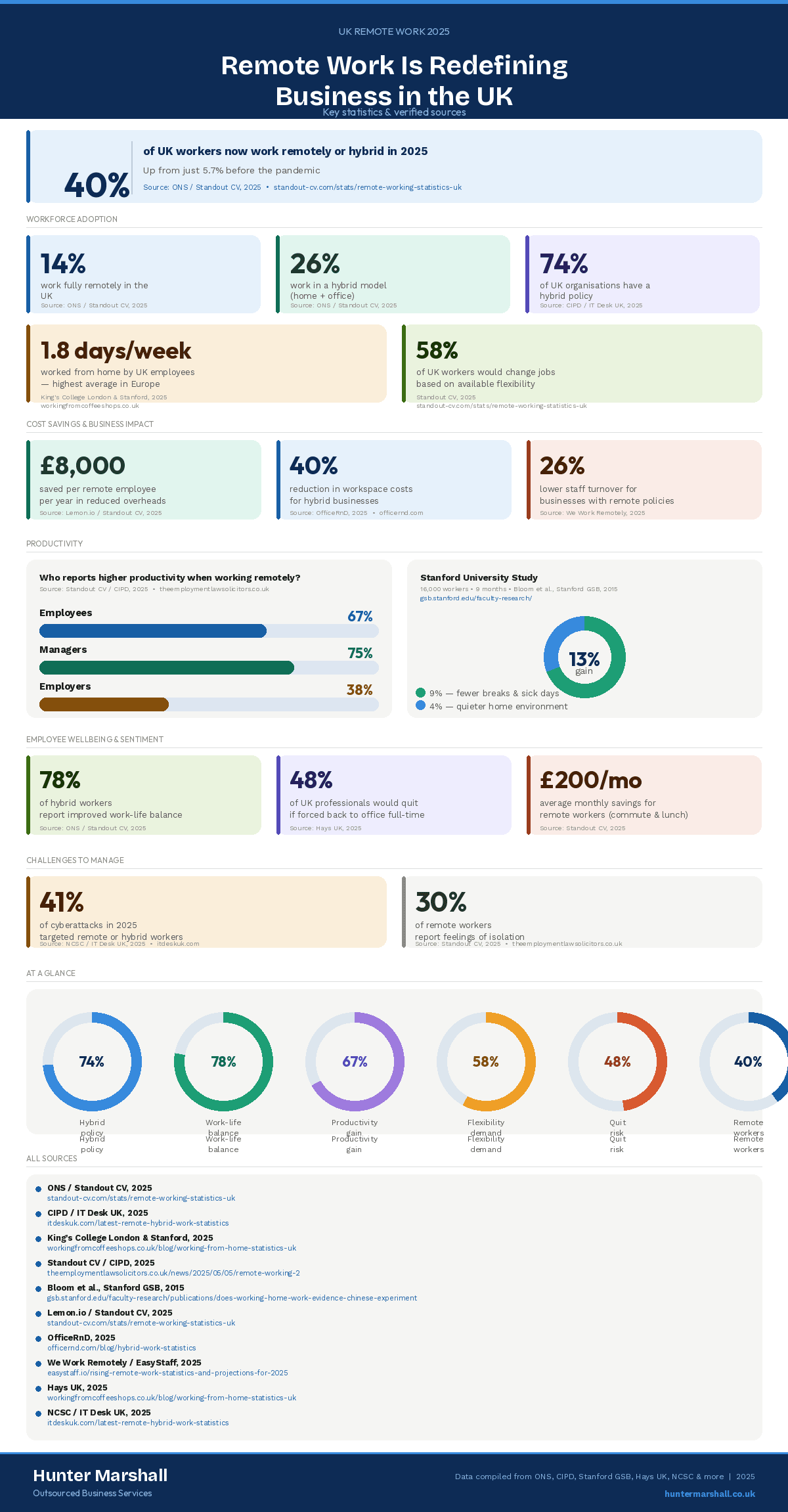
The growth of the remote workforce in the UK is reshaping how organisations hire, manage teams, and deliver results. According to the Office for National Statistics (ONS), 40% of UK workers now work remotely or in a hybrid arrangement, up from just 5.7% before the pandemic. As businesses adapt to these permanently changed expectations, remote and hybrid work have become central to the future of business in the UK.
Key Facts at a Glance
- 40% of UK workers currently work remotely or hybrid as of 2025
- 74% of UK organisations now have a formal hybrid work policy in place
- 58% of UK employees would change jobs or relocate based on available flexibility
- Companies save up to £8,000 per remote employee per year in reduced office costs
- 67% of employees report higher productivity when working away from the office
The Challenge Of Hiring, Retention, and Rising Costs
UK businesses face mounting pressure across three interconnected areas: talent acquisition, workforce retention, and operational cost management.
Key issues include:
- Talent shortages in specialised roles
- Rising employment and operational costs
- Employee demand for flexible work arrangements
- Intense competition across industries
- Major traffic congestion around many main motorways
To address these challenges, companies are adopting distributed teams in the UK and leveraging remote staffing solutions in the UK to stay competitive.
The Rise of Hybrid Work Across the UK
The shift toward hybrid work in the UK has become a defining trend in the business landscape.
Why it’s gaining momentum:
- Employees increasingly treat flexibility as a non-negotiable standard, not a perk
- Businesses are actively reducing costly office space commitments
- Technology enables seamless remote collaboration at scale
- Organisations are shifting to measuring productivity by output, not presence
As a result, companies are expanding their hiring strategies and creating more remote jobs for UK companies. Hunter Marshall understands this and provides detailed business services.
Scale your team without scaling your costs
Hunter Marshall Remote Outsourced Business Services Solutions for Your Businessthat cost at least 60% less than hiring locally
Key Benefits of Remote Work for UK Businesses
Broader Talent Access
Businesses can hire beyond local regions — removing geographic barriers and gaining access to specialist skills that may be scarce locally.
Reduced Operational Costs
Research shows companies can save up to £8,000 per remote employee per year through reduced office space, utilities, and overheads. Hybrid models have been shown to reduce workspace costs by as much as 40%.
Improved Productivity
67% of employees and managers report higher productivity and better concentration when working remotely. Stanford University research further found a 13% productivity increase linked to quieter home environments and reduced sick days.
Higher Employee Satisfaction
78% of remote and hybrid workers report an improved work-life balance, while businesses with strong remote work policies see turnover rates up to 26% lower than fully on-site competitors.
Greater Business Agility
Distributed teams allow companies to scale operations quickly, respond to market changes, and maintain continuity during disruptions (from supply chain events to economic headwinds).
The remote workforce in UK is enabling organisations to build more resilient and scalable operations.
How UK Companies Are Adopting Remote Models
Remote work is being embraced across multiple sectors in the UK, with different industries finding models that suit their compliance, collaboration, and client needs:
- Tech companies are building distributed engineering teams
- Marketing agencies are hiring remote creatives and strategists
- Financial firms are adopting hybrid models for compliance and flexibility
- Professional service firms (legal, consulting, HR) like Hunter Marshall are outsourcing specific functions to manage costs without sacrificing quality
For example, a London-based company may combine in-house leadership with remote teams handling development, support, and operations.
With the help of Hunter Marshall, businesses are efficiently managing distributed teams in UK while reducing operational complexity.
Making Remote Work Sustainable
Adopting a remote workforce in the UK is only the first step. Sustaining it effectively requires deliberate structure, clear culture, and the right tools.
Important steps include:
- Setting clear expectations, KPIs, and output-based goals from the outset
- Using reliable communication and collaboration tools and platforms
- Building a genuine and strong remote-first culture
- Encouraging transparency and accountability, and regular team check-ins
- Tracking performance based on results and measurable outcomes
Many organisations are now working with Hunter Marshall’s outsourcing services and remote workforce in UK, to streamline management and improve efficiency.
The future of work in the UK is flexible, distributed, and global
Is your business ready?
Partner with Hunter Marshall and start building the team that takes you there.
The Role of Outsourcing in the UK Market
Outsourcing plays a vital role in enabling remote work across the UK.
By partnering with Hunter Marshall, businesses can:
- Access verified global talent quickly, without lengthy in-house recruitment cycles
- Reduce hiring time and costs
- Scale teams based on commercial demand
- Improve operational efficiency with experienced, pre-vetted remote professionals
As a trusted provider of remote staffing solutions UK, Hunter Marshall helps businesses maximise the benefits of the remote workforce UK.
Common Challenges of Remote Work and How to Overcome Them
The remote workforce in the UK is not without its challenges. Understanding them is the first step to addressing them effectively.
- Isolation and reduced connection: 30% of remote workers report feelings of isolation. Regular virtual socials, structured check-ins, and clear communication norms help.
- Cybersecurity risks: 41% of cyberattacks in 2025 targeted remote or hybrid workers (NCSC). Investing in VPNs, endpoint security, and zero-trust models is essential.
- Productivity visibility: Only 39% of employers believe remote staff are more productive, even though 67% of employees report the opposite. Output-based KPIs help bridge this gap.
- Work-life boundary management: Without clear routines, burnout risk increases. Encouraging defined working hours and digital switch-off time is critical.
Conclusion: Preparing for the Future of Work in the UK
Remote and hybrid work in the UK is no longer a temporary accommodation. It is now a permanent feature of the UK employment landscape. The UK ranks among the top three countries globally for hybrid work adoption. Companies that fail to adapt risk losing talent, competitiveness, and revenue.
By leveraging flexible work models and global talent through Hunter Marshall remote staffing solutions UK, organisations can build stronger, adaptable, and more cost-effective teams.
If you are looking to scale your business with remote talent, Hunter Marshall can support your growth journey.
H2- Data-Backed Insights On Remote Work That Every Business Leader Needs